

Author: frankschulz-hcc

  • Work Life Balance

    Work Life Balance

    When candidates tell you that they do not want to work overtime, or do not intend to commute to the working place for more than 40 minutes on one way, then one shall assume that the “work-life balance discussion” has also reached Japan.

    The general understanding is that the term means to find a suitable balance between a person’s professional and private lives. This is a challenge, especially for working parents, married couples or single mothers or fathers.

    To combine professional and private commitments is not only important for the well-being of an individual, but also for all other family members and colleagues at work. To stretch it even further, work-life balance is beneficial for companies and society itself.

    It is only logical that the more a person works, the less time is available for other activities – like socializing, following a hobby, travelling, eating or even sleeping. Re-charging the battery, i.e. having time to spend for leisure and relaxation, is important for the overall well-being, and brings physical and mental health benefits.

    Nevertheless, the question has to be asked if the idea of work-life balance is in line with the Japanese living and working reality.

    What Does Work-Life Balance Stand for in Japan?

    As I mentioned in one of my last columns: “Speaking with regard to the traditional (employment) system, a still very common viewpoint is that success of a corporation relies on the motivation of its employees and their strong sense of loyalty to and identification with the company.”

    This includes the tendency to connect one’s professional destiny with the company and leads to a life-long employment system, seniority-organized working groups and a high amount of overtime.

    In Japan, it definitely is a question of socialization and acceptance by society if work-life balance matters will be seen as important for its well-being and not as a degradation of cultural and ethical values.

    The trend of Japan becoming an over-aged society combined with low birth rates are threatening Japanese prosperity, and already has triggered discussions how to transform social norms, kick-start gender equality at the work place, and develop reform policies.

    Already eight years ago, a work-life balance campaign was launched by the Ministry of Health, Labor and Welfare. It declared 2008 to be the “inaugural year,” from which on social, demographic and labor issues should have been in the focus for change.

    Yet the central and most important issue with regards to work-life balance policies and understanding of the matter are the aspects of labor, for example the limitations that parents are facing, particularly women and single mothers.

    On second rank, problems of gender equality are in the focus.

    The third rank embraces problems of the labor market, the over-stretched habit of working overtime and different working styles and professional attitudes of the young and elderly members of the workforce.

    Let me share some of my thoughts on these points with you.

    Family Matters

    Japanese parents are facing especially high hurdles in bringing together work and family commitments. Habits at the workplace, high living expenses like housing, school and private tutoring center fees, and social norms put young and mid-aged people under pressure.

    The results are clearly visible. The marriage age is on arise, parenthood is delayed, and the nuclear family with one child is the given trend.

    Japan’s population has started to decline. A fertility rate of 1.4 in 2015 shows the dilemma of the “lowest of the low” fertility countries world-wide. The forecast for 2016 and after is even worse.

    Work Life Balance in Japan - Subway

    It will be crucial for the government, but also for corporations, to increase childcare policies to strengthen parental employment. The provision of appropriate facilities like yochien kindergardens, hoikuen day and night-care centers, and pre-schools, the reduction of educational costs, the avoidance of private facilities with their business-like approach and long-time waiting lists, selection methods and so on, has to cater to family needs and not be handled as an end in itself.

    Corporate kindergardens also could trigger employer branding and create more attractiveness for potential employees, even if this will only appeal for companies of a certain size and with financial resources.

    Women Matter

    Shouldn’t it be a general trend in the year 2016 that female employment and career development be treated as a given?! Is it too much to ask for that educated Japanese women would like to make good use of what they have learned and establish a career before thinking of family planning?!

    The short answer is YES! Especially in an over-aged society, where all hands have to be on deck to keep and guarantee the living standard and well-being of its members. It is quite surprising how exclusive a society can be which is defining its existence as a homogeneous group. Is it a luxurious habit to exclude or is it an act of foolishness?!

    However you may answer this question, it is a practice that once Japanese women re-join the work-force after having left it to care for their children, they normally end-up in part-time, temp-staff and other forms of non-regular employment – mostly being low-paid and over-worked.

    Women have to be offered better opportunities when re-entering regular employment. Those who do not have to work to make a living may just stay at home rather than return to low-quality employment.

    As long as there is no guarantee that female work-life balance matters are treated as an important factor, the result will be low-birth rates, lower levels of female employment, and even the trend to marry late, or even to avoid it.

    This all in a time when Japan needs to challenge the problems of over-aging.

    Employment Matters

    The vivid problem of how to avoid overtime, long working hours and to make employees taking all their paid vacation is part of many discussions.

    The introduction of Flextime Systems could be one solution, income systems nurturing individual results rather than presence a further one, the granting of paid sick leave days another, and an intact company culture not based on habits another one.

    Flextime Systems give employees discretion over their hours of starting and finishing work. They also may nurture pro-activity and responsibility. Work can be started and finished based on core time agreements of several hours in the morning and afternoon. Super Flextime Systems with no core time agreements could be customized based on needs as well.

    SOHO – small office home office – solutions could offer a reasonable solution as well as soon as the employee does not have to be present at the company every day of the week. The support of evening work would not be appropriate because it may lead again to overtime work.

    All of these systems require to be mentioned in the rules of employment and normally a majority labor agreement reached with the employees. There is no necessity to notify the Labor Standards Inspection Office.

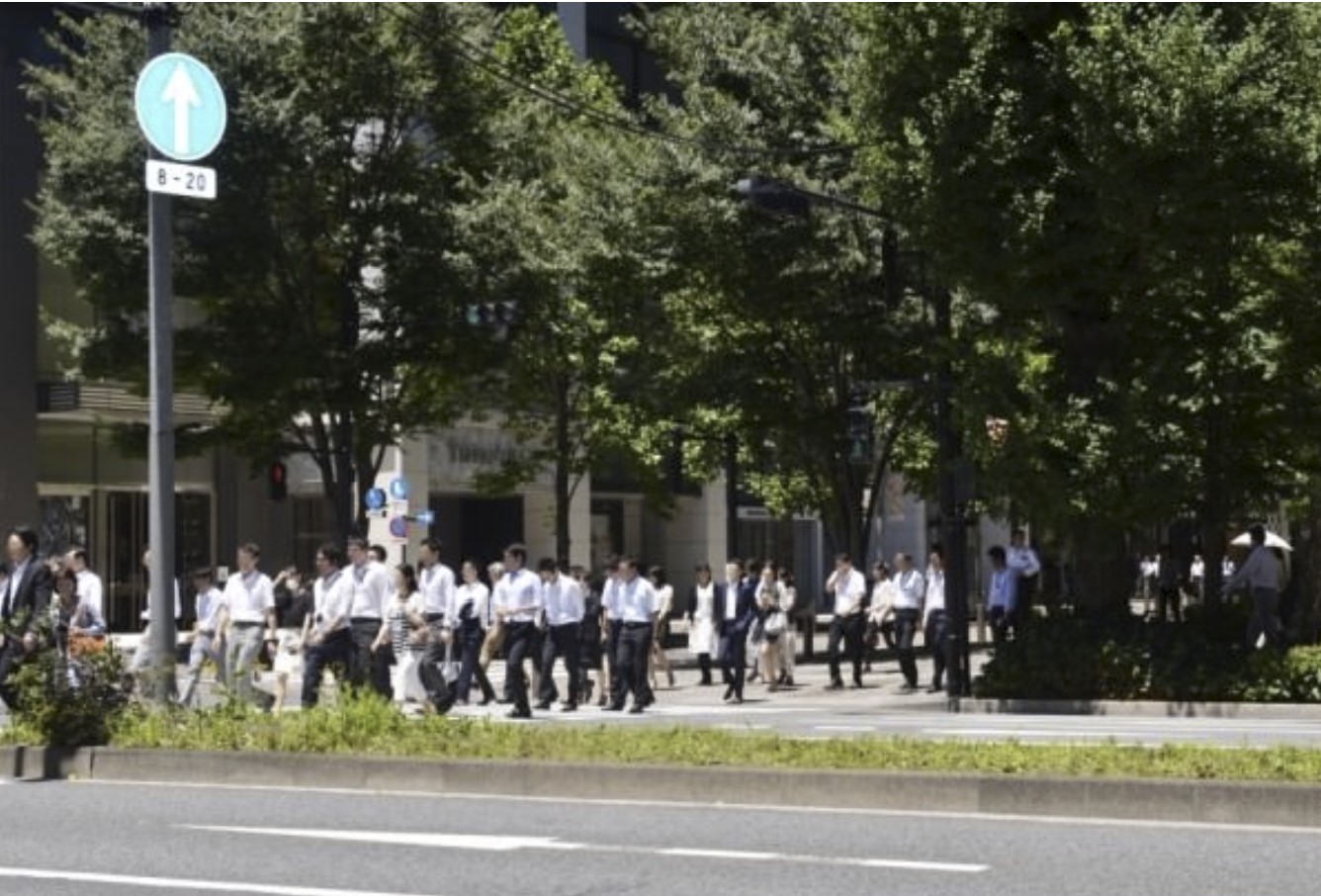
    Work Life Balance in Japan - Marunouchi Office District

    A company is expected to pay overtime if employees – unless they belong to management – work over 40 hours a week. If a company intends to use overtime on a regular base, it should reach a written agreement with its employees and submit it to the Labor Standards Inspection Office. The agreement refers to Article 36 of the Japanese Labor Law and should be re-discussed every year.

    This agreement also would provide the possibility to set overtime limits based on position responsibilities and requirements. It shall avoid that an employee sits at his desk with nothing to do until the headlights are shut down.
    Overtime hours have to be limited to five hours per day, 45 hours per month, and 360 hours per year. There are exceptions in place especially for technical service focused positions. Nevertheless, this shall be done by mutual agreement.

    The Japanese Labor Law regulates overtime payment. Just as an example: overtime typically after eight hours of work on a day leads to an extra payment of 25 percent of the hourly base salary, and overtime on weekend and holidays would be at 35 percent of the hourly base salary.

    Beyond variable portions of their income, some employees may need the overtime payment as foreign companies in Japan sometimes tend to pay under market standards. To raise the salary up to standard could avoid exorbitant overtime payments. A company culture of leaving in time after the eight hour working day used strictly for work matters, and not socialization, could also solve the problem.

    Paid sick leave – in general employees are not entitled to sick leave rights in Japan. Normally, when an employee gets sick, he uses his paid vacation. Some foreign companies grant paid sick leave as a special benefit, but not all.
    The Labor Law stipulates the amount of paid vacation based on seniority. The frame here starts with 10 days after a 6-month period belonging to a company and can be added up to 20 days after 6.5 years of working there in a row.

    Even it is easy to propose, but to offer paid sick leave to employees, to encourage them to take all their paid vacation, and nurture their focus for work-life balance can strengthen employer branding and create interest of potential employees to send in their resumes.

    In case of any questions or remarks please feel free to get in touch!
  • Shadow Hierarchies

    Shadow Hierarchies

    This phenomenon exists not only since 2011, when many foreign expatriates in Japan have left the country all of sudden because of the Tohoku Earthquake and Tsunami.

    Yes, the event caused a leadership vacuum in some organizations many did not recover from until today. But its origins nevertheless are older and also truly local due to the group-oriented socialization of Japanese professionals and the organizational structure of foreign companies in Japan.

    Not every foreign company in Japan is affected by this unfortunate phenomenon and of course not every Japanese professional will support it!

    Business men figurines

    Shadow Hierarchies can especially be found in mid-sized and large-scale enterprises. I am referring to a short- and mid-term condition mutually tolerated by all parties involved to preserve a status-quo. But when developing into a long-term situation, it will cause alienation and a serious divergence to the strategic direction given by the parent company.

    Although the situation is highly influenced by management style and atmosphere in each company, a “we and them” condition which differentiates between seconded and local employees is not beneficial.

    But what does it mean? In general, a coherent working group consisting of Japanese professionals led by a local senior manager for a steady number of years faces a periodical turnover of expatriate management. Expatriates in Japan are generally staying for an average duration of three years. This sometimes leads to a repeating vacuum exploited by local management, a “permanent staff vs. visitor situation” with regards to the organizational identity.

    The situation can also be caused by a parent company not knowing about local requirements and not actively engaged in leadership and organizational development.

    A management vacuum in Japan is naturally filled by seniority and not qualification. A title helps but only when gained by long years of service.

    Shadow Hierachies Work Through the Control of Information

    At times I hear in discussions with Japanese managers employed by foreign companies that seconded expatriates are being “sat out,” for example through limited exchange or withhold of information and interpretation of management decisions. Knowledge for the sake of action or control means to own power in a working environment. Withholding it and alternation can undermine the hierarchy status of management.

    Since many expatriates also do not speak the local language there is a chance that they are partially missing what is going on in their organizations.

    Are statements like “I feel not well informed,” or “I think they are passing me by,” or “our Japanese management is just feeding info to me I shall hear and hides the rest” only a sign of weak leadership, lack of communication, or intentional wrong doing? Or do they more mirror limits in commitment, cooperation, cultural understanding and support? May disinterest also be part of it? Is the preservation of a certain status-quo or truce a target to go for?

    Yes, I know about the problems, but to tackle them could disrupt our activities and may have a negative impact on my career because I have a limited time left in Japan.

    The latter one definitely applies when I hear a sentence like “Yes, I know about the problems, but to tackle them could disrupt our activities and may have a negative impact on my career because I have a limited time left in Japan.”

    Well, I think the answers to these questions are as individual as each foreign company and its personnel being active in Japan. Goodwill and character can quite be part of an answer.

    Otemachi Tokyo

    I was informed about a particularly serious case by a younger expatriate who was only recently dispatched to Tokyo. To him it was clearly stated by some members of the local management that he would only enjoy a limited toleration and that there is no reason for his stay because his responsibilities could be better covered by them.

    Although these topics are of concern, there are more which need attention – for example, when hiring external mid-careers.

    If Japanese managers of a foreign company are involved in hiring processes, there could be a tendency that they more likely do prefer conformists over achievers.

    There are two reasons for this, fear of new internal competition and possible disturbance of working group harmony. Nevertheless, the concept of harmony in Japan should not be viewed through romantic spectacles of the West. Especially in a professional environment it is nothing less than forced conformity mutually accepted by all members of the work group.

    Greater attention should be paid, for example, if as reason for refusal it is cited that the character of the candidate is questionable, or would not fit because he worked only with foreign companies, if interview appointments are postponed into the future, feedback is contradictory, or requirement profiles are suddenly questioned.

    Since foreign companies for various reasons do not appeal as attractive to local candidates as Japanese do, there is always the danger that the needed achievers cannot be obtained.

    Some Japanese managers in foreign companies contribute little to improve this situation, as they are in many cases supported by this system. Also the term of the “nail which sticks out…” should not act as an excuse.

    A key differentiator to Japanese companies namely that of internationality which implies attractiveness, like individual performance and its recognition by offering of potential career opportunities and income development is often thwarted.

    At the end, the foreign company and the whole organization in Japan suffers because the business is weakened. Performing employees are looking for new challenges, go to an inner resignation, or take sick leave. The ones who stay have arranged themselves mostly with the situation.

    To control this negative development, I recommend stronger involvement of the parent company in HR processes, active influence of foreign executives in Japan to counteract and, especially in case of hiring, non- or closely-monitored delegation and direct decision making.

    To avoid it will take a good amount of goodwill, follow-ups with high engagement in the local meeting culture, continuous four-eye discussions, assessments, and leadership by example.

    In case of any questions or remarks please feel free to get in touch!

  • The Japanese Candidate

    The Japanese Candidate

    “We have difficulties in finding the right people,” or “there are not enough suitable candidates available in Japan” are only two sentences I am hearing too often. Domestic hiring is without a doubt a question of supply and demand, and method. But there are other factors, too.

    Before tackling the topic, let me throw in some general information and statistics.

    The total labor force potential in Japan as of February 2016 consists of 66.7 million people, which cover 59.7 percent of the local population of over 15 years of age. Amongst them 64.6 million people are employed and 2.1 million unemployed, which results in an unemployment rate of 3.2 percent.

    The 1990’s Bubble Economy brought about changes to the local labor market which stretch into the present. These days we face an over-aged society, gradual retirement of the baby-boomer generation, and stagnating career potential for female professionals. We also see rising education levels, which include better information gathering and decision making.

    Another topic still flying under the radar is an increase in numbers of foreign professionals. Japan is seen as a country with a low immigration level. So far an estimated number of 790,000 foreign nationals are working in Japan legally. This number is based on an estimation by the Ministry of Health, Labour and Welfare done in 2014 and covers blue and white collar workers. A statistic of the Ministry of Justice nevertheless counts more than one million people because the chance is high that not all employers report the number of foreign workers they use.

    Well, let us book that under corporate creativity and move on.

    Japanese Employment Practices Tradition vs. the New

    The Japanese employment practice was and is known as “new graduate recruiting” and “lifetime employment” which includes hierarchies and wages based on a seniority system.

    After being hired the young employee through the years has to learn general skills gathered by “on-the-job-training” and “job rotation.” With the focus on a long-term career. The last third of his career he has to face a bottle neck which divides the middle from senior and executive management positions. No one will be left behind or side-lined in the working group, but not everyone will be able to reach the upper management positions.

    Since every Japanese company owns its firm-specific system of education and skills it was nearly impossible to change the employer. This circumstance worked well so far for Japanese companies.

    Tokyo Subway Shibuya Station

    They may has started as a reaction to the economic-bubble burst, but I personally felt that slight changes have occurred since I began working in the executive search industry here in Japan.

    Some Japanese companies have opened themselves for mid-career hiring and the respective performance based payment schemes, also for part-time and temporary workers – although the main reason for the introduction of the latter stands not for a pro-active change in human resources management but the minimization of labor costs.

    Ultimately this has led to a dual-class employee system, where traditional and modern hiring practices are existing side by side and are causing an ambivalent situation.

    Speaking with regard to the traditional system, a still very common viewpoint is that success of a corporation relies on the motivation of its employees and their strong sense of loyalty to and identification with the company.

    Japanese professionals are also low risk takers and the traditional employment practice still nurtures the tendency to connect one’s professional destiny with the company.

    But times are changing and a good number of Japanese professionals start to understand that a career has to be planned individually and shall not just be left to the employer’s agenda. The younger generation also has a different attitude toward work in relation to the “work-life balance” discussion.

    What Can a Foreign Company in This Situation Do to Attract Japanese Professionals?

    First, start thinking about “employer-branding.” Coexistence in the group-orientated society in Japan is traditionally a matter of information exchange, more intensive and detailed as we know it in the western world. The decision-making process is based on a sometimes overwhelming amount of information gathering to reach approval and eliminate risk. This attitude also counts for the individual.

    Just to name one example it is hard to understand why the internet presence of some foreign companies of either size is lacking a Japanese language edition, or information in detail about the organization and activities in Japan, and references by employees.

    Offer more than just a position profile by giving a thought to career development. Some foreign companies are too static in this regards. This can mean having a decent approach to trainings, a mentor system, or the introduction of short or mid-term employee dispatching on international level. There are several tools available to foster attractiveness as an employer and also talent and qualification on the employee side.

    Create and show commitment to the market and also to your employees. Those concerned will know if a foreign company owns such commitment or not. It has to be nurtured by the local executive and senior management. It is a question of character and authenticity. Otherwise it would be difficult to understand why Japanese professionals choose a not well-known small- or mid-sized company as employer and neglect well-known larger players. It also explains why they sometimes accept lower income levels when joining a company, and that the income is not the most important factor to attract employees over here.

    Be even prepared to invite family members of potential employees to create good-will. Only a small number of Japanese professionals are making a job change decision individually. The “mother in law” factor, as I call it even if the “wife factor” is more common in case of a married candidate, is an important parameter to be recognized. Up to a certain degree the decision if a candidate joins a foreign employer is made within the candidate’s family.

    Another hint I can give you is to start seeing Japan as a region for itself, detached from Asia-Pacific region models where Human Resources management is handled centrally. Try to get independence if you are part of a group of companies and Human Resources are handled under one umbrella as a joined service. Centralized approaches are generally not well received with Japanese professionals.

    There are several other points to be mentioned which will be the topic of further columns.

    In case of any questions or remarks please feel free to get in touch!

  • Methods of Hiring

    Methods of Hiring

    As one result of a globalized economy and a declining population the “war for talents” has reached Japan. The first generation of baby-boomers also is going into retirement and the rate of unemployment, 3.6% as of January 2015, is shrinking. Together this leads to a shortage of manpower. A low birth rate and an over-aged society will play its part in the future as well.

    The hiring of university graduates alone as it was the traditional method for Japanese companies so far to find “white collar” personnel cannot longer fill-in the gap and is not well-established with foreign companies here in Japan. One reason is an educational system which in general orientates itself more on socialization then gaining academic knowledge to build on.

    Domestic companies have begun to re-think their hiring strategies. Foreign companies as well are feeling the pressure when it comes to hiring management candidates on different levels. For both groups the externally hired mid-career candidate is firmly in focus.

    Japanese managers continue to show a high degree of loyalty towards their employers. But the attitude to build an individual career path is on the rise.  Was it unthinkable a few years ago to be open for an external career step, it is now not uncommon to consider suitable possibilities.

    Experience nevertheless shows that employers are preferred which show a high stability, prospects, commitment to the market and local customers, and are able to convince with their product and service portfolio. Other factors of attractiveness include the step-up to a higher position with more responsibility and the offering of a performance-based compensation system. The company location is also crucial in a country that tends towards centralization. Tokyo is and remains the center of the labor market. Companies that are located in other prefectures complain more often about less good chances of getting qualified staff.

    The Japanese society in general still rather expects of men to pursue a professional career, women are often not recognized as potential candidates for specific management and technical positions. Female careers are shorter and mostly done in the administrative area. In other areas such as Human Resources, Marketing or Communications they occupy mainly staff and line management functions.

    Even if Prime Minister Abe has announced “Womenomics” to initiate a policy change, the given situation includes a perfect chance for foreign companies to find well educated female employees who do not want to accept the traditional role perception.

    Only by 2020 female professionals shall occupy about 30 percent of the leadership positions in domestic companies. But by 2015, only 7.5% of the total management positions at companies with over 100 employees were filled in with female professionals.

    Another alternative to prevent employee shortages would be the opening of the labor market for foreign workers which is already to some extend recognized i.e. in the nursing field.

    Nevertheless, Japan has not yet connected itself to the “candidate high way” that extends from Seoul to Singapore and Dubai, on which already potential management candidates actively move. So, recruitment is usually still a purely domestic matter.

    Methods

    Even in Japan companies can attract potential employees via the advertisement of vacancies in print media, including all major newspapers such as Asahi Shinbun, the Yomiuri Shinbun, and the Nihon Keizai Shinbun (Nikkei). The Nikkei in particular seems to be more eligible as it is read mainly by managers and specialists. An ad in the English-language Japan Times may attract potential Japanese candidates but is mostly read by foreigners.

    But price and performance are not indicators which relate to each other. A single placement of a 5.5 x 6.0 cm ad can easily exceed 1.0 Mil. Yen.

    Another option is the Internet, which has become the most popular medium for job searches in Japan.

    Beyond others, sites like Daijob or en-japan are widely used. Companies can actively place ads, screen potential candidate CVs and later on get in direct contact. They can be used either on a monthly membership or one-time basis – the cost varies accordingly.

    Both search paths attract potential candidates who are actively seeking a new job. But also trigger a wave of initiative applications which may not fit to the job profile.

    Employees for non-management positions can also be found through temporary employment agencies, recruiting fairs, outplacement agencies, employment offices at universities, or the unemployment office known here as “Hello Work”, also via recommendations and word-of-mouth.

    For the search of middle, senior and executive management candidates nevertheless the method of direct approach is the most appropriate.

    The recruitment consultant market with approximately 15,000 companies throughout Japan is still far from being mature and consolidated. As the industry has set no adequate standards it shows uncontrolled growth in regards to professionalism. For example, a license is necessary but can be gained by everyone. Qualifications and competence are not required.

    Basically there are two groups of personnel consultants, Contingency agencies and Retainer firms. The first makes up around 95% of all search companies in Japan.

    Contingency agencies collect candidates willing to change even without reference projects through their homepages or use internet searches or cold callings.

    Resumes are entered into database and are accessed based on project by keyword search and send to client. Since these companies receive a payment only in case of successful placement they typically rely on presenting their clients many resumes to choose from. But little time is spent with the compilation of search profiles and active candidate assessment.

    Depending on the agency, they charge between 20 to up to 40% of the first annual gross income of candidates.

    Some Contingency agencies are working reliably well. But as the industry is relatively unregulated, there are a few “rotten apples.” Staffed with inexperienced agents, they act aggressively focused on own turnover and with a low level of compliance.

    Which unfortunately makes our industry not always appear in a good light in the eyes of potential candidates, and sometimes clients.

    The second group comprises the Retainer firms known under the term Executive Search. They focus on higher management positons and the first ten internationally renowned foreign personnel consultancies mostly have offshoots in Japan.

    Searches are normally performed based on detailed position profiles and under compliance with strict off limits in regards to target company lists, and confidential handling of individual candidate and client information.

    Consulting fees of these companies generally cover 30 to 35% of the first annual gross income plus offered fringe benefits of the candidate employed. They do not charge on successful placement, but in fixed instalments either on a time or milestone retainer structure.

    Again, there are differences depending on the company, the qualification and experiences of consultants, the search approach and the understanding of the market.

    Belonging to the latter group of consultants I am working here in Japan since 2003 and serve international and domestic companies active or to be settled in the local market. I hope that the points raised found your interest and invite you to read my upcoming columns here at the Japan Industry news site.

    In case of any questions or remarks please feel free to get in touch!